Blog
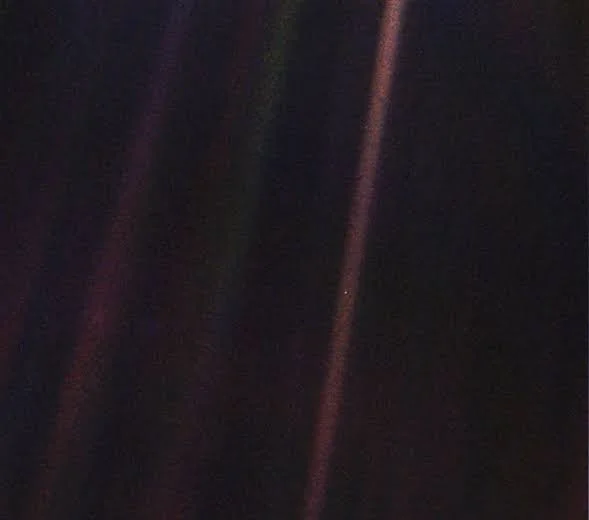
Voyagers Like Us
And yet, when I leash up my big fuzzy dog Tiny and take him outside for an evening walk in rural Northern Minnesota in a season of ever-shorter days, I still look up. A clear night sky on a crisp evening still inspires that sort of wonder that projects like Voyager and science communicators like Sagan (not to mention the late great Patrick Stewart and Star Trek: The Next Generation) once imparted to me. And I recognize that despite the fact that science as a publicly-funded enterprise (rather than an avocation of pallid upper-middle class eccentrics, as in the more distant past) has been put with less than noble motives to less than noble ends, there is still a message in milestones like Voyager that remains important, maybe even more so now.

AI, Music, and Social Science
There are a lot of criticisms of AI. Some strike me as valid; others do not…but when I pause to think about exactly what AI applications in a certain domain, such as music, should be allowed or forbidden, I am at something of a loss. This is a shift from social problems to the aesthetic, artistic, dimension. I can’t seem to escape the Enlightenment tendency to treat the aesthetic as something subjective, relative to the eye of the beholder. As a middle-aged guitar player who has spent thousands of hours learning to play, there’s the tempting reactionary tack, that people who use AI to make music aren’t “really” musicians, because they don’t “really” play an “instrument.” Here’s why I think that’s arbitrary, silly nonsense…

Puzzle Theory
Lately I’ve rekindled a love of jigsaw puzzles I first developed in childhood. My wife and I bought a David Bowie puzzle shortly after our beloved dog Chewie passed away last January. We also got a puzzle as a gift from some friends a bit before that. This year, being a mature, middle-aged man, my wife bought me a He-Man puzzle for an early birthday present. Just about everything I love to do has a “puzzle” element to it; there’s a way that putting together puzzles makes your brain work that really appeals to me and that reflects in my other goals.

Parsimony, Plans, and the Gum Wrapper Guitar Amp
I found two easy ways to practice what I preach, to stop functioning from overwork to burnout like that crappy old guitar amp.

A Matter of Time
People, especially we denizens of western civilization, are often linear critters. Things had a beginning and will have an end. Life is a journey from birth to death to whatever comes after that (I don’t pretend to know). We mark off lives in time relative to predictable expectations and norms and “acting our age.” I am entering what is called “middle age,” bringing with it the expectation that my life is halfway between its beginning and its end, as well as expectations about what I should or shouldn’t do. This linear story often has “high points” and “low points,” an expectation of “glory days” and “good times” (usually in the younger years) and a long, steady decline full of anxiety, nostalgia, and reaction beginning around 40. Is this why middle-aged people so often start thinking the world is coming to an end?